


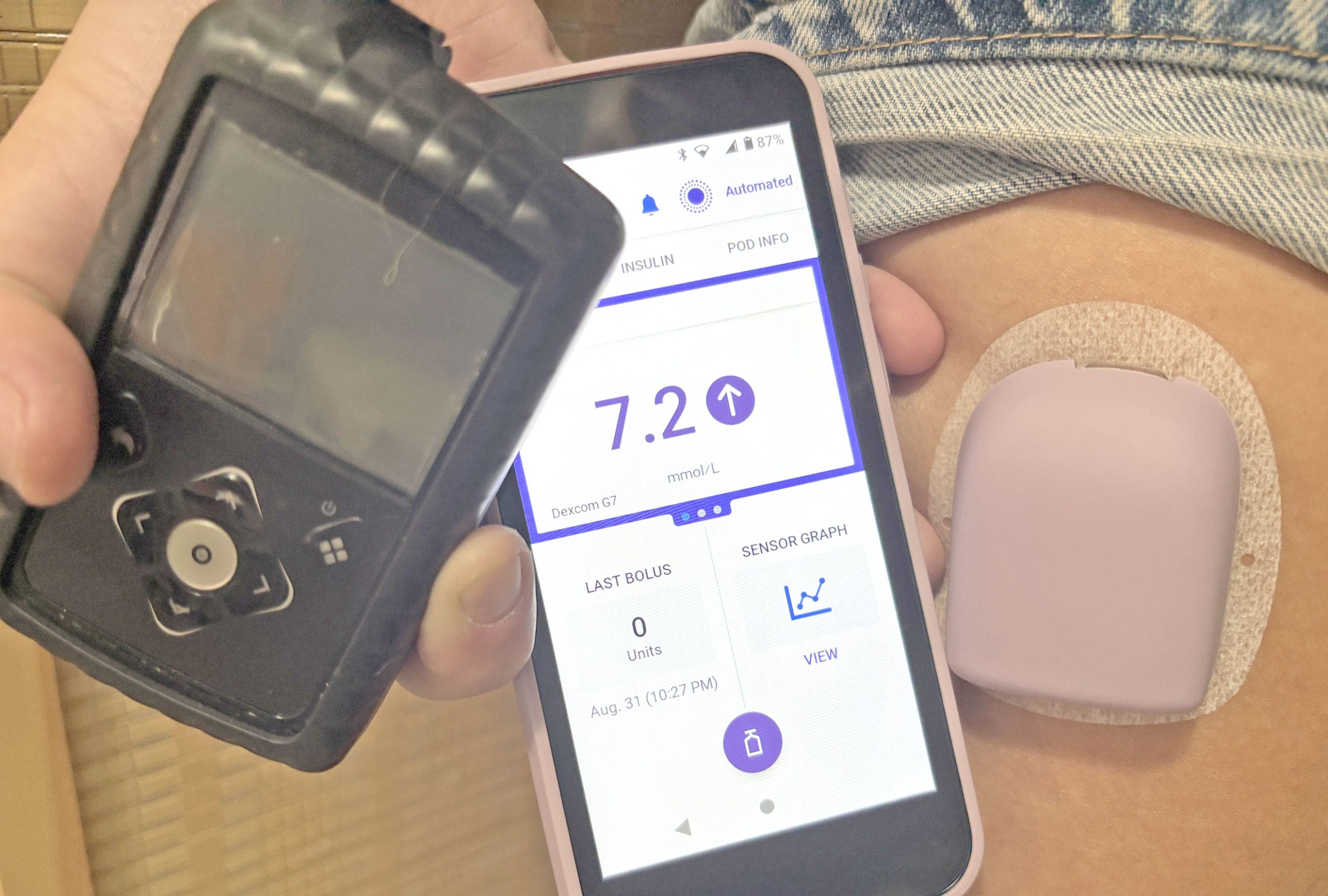
I was six years old when I got my first insulin pump – a year after I was diagnosed with Type 1 Diabetes (T1D).
It was a Medtronic MiniMed Paradigm pump, and in the years since, the models have changed, the technology has improved, and I have grown up – but the basic concept has remained the same.
There has almost always been a small electronic device clipped somewhere to my clothing, connected to my body by a length of tubing and quietly keeping me alive while others ask if I got the new MP3 player or iPod.
So, after spending most of my life with Medtronic, I decided a few weeks ago that I would switch to the tubeless Omnipod 5 system since they had a promotion going on where you could switch over without paying the standard program fee.
This feels like a much bigger change than simply choosing a different brand of medical device. Such a small change that requires no tubing will allow me to feel just that much more free.
It has also reminded me just how expensive it is to have T1D.
Diabetes is one of those diseases where the financial burden can sometimes become almost invisible to the people around us. Insulin, pump supplies, glucose sensors, test strips, needles, alcohol swabs and the countless other things we accumulate aren’t optional purchases.
I don’t buy them because I want them. I buy them because my pancreas doesn’t make insulin, and I want to stay alive. And while Canadians are fortunate to have government programs that help with those costs, “covered” doesn’t always mean free.
In Ontario, the Assistive Devices Program (ADP) covers 100 per cent of the ADP-approved price of an insulin pump for eligible people with T1D. It also provides up to $2,400 annually toward insulin pump supplies, distributed in $600 payments every three months.
That sounds substantial – and it is. I am incredibly grateful the program exists.
But $2,400 a year is $200 a month, and anyone who has spent time ordering diabetes supplies knows how quickly $200 can disappear. My new Omnipod pods, as an example, are priced at $334 per box of 10, and I have to take them out and put in a new one every three days at most. This means I am paying about $130 out-of-pocket every month going forward.
Diabetes Canada reports that out-of-pocket costs for a person living with T1D can reach as high as $18,306 per year in some circumstances, depending on where they live.
The organization has also found that more than half of people living with T1D either face costs exceeding three per cent of their family’s annual income or, when combined with other financial pressures, do not fully adhere to the treatment recommended by their health-care provider.
Think about that for a second.
This is a disease where taking insulin isn’t optional. Without insulin, a person with T1D dies.
There is federal help, too. Canadians with T1D qualify for the Disability Tax Credit (DTC) under the federal government’s life-sustaining therapy provisions. For 2026, the federal government says the DTC amount is $10,341, providing a federal tax reduction of up to $1,448.
Again, that help matters. But the DTC is a non-refundable tax credit. It isn’t a $10,341 cheque handed to every Canadian with T1D to pay for their supplies. That distinction matters when we’re talking about affordability.
Yet switching insulin pumps has still required me to think about money at practically every stage.
I only started using the Omnipod the night before this column goes to print, so I cannot give it a fair review. Although it is more expensive out of pocket than the Medtronic 780G I was using, it is worth it to me to splurge so I don’t have to be connected to a tube, and I now have more freedom.
I was telling my family the other day how excited I was to be able to wear dresses again without having to worry about where I am going to clip my pump. And now I can wear pants that have no pockets – although I’m not so sure pants without pockets were a great invention to begin with.
I am also excited to enter into the world of what us T1D’s know as the “closed-loop system.” This means my new pump and continuous glucose monitor (I use the Dexcom G7) can communicate with each other.
Now, if my blood sugar is trending high, my pump will automatically give me more insulin based on my numbers. If I am trending low, it will automatically suspend insulin. I will still have highs and lows, but I am excited to have (hopefully) a lot less of them.
However, if it weren’t for the promotion that just ended, I would still be doing everything manually, because switching pumps is expensive. I essentially saved $1,500 by using the promotion.
Maybe that is the part of living with diabetes people don’t always see.
They see the sensor on my arm. They see the insulin pump. They might hear an alarm go off or watch me check my blood sugar. But they don’t see the receipts.
They don’t see the calculations behind deciding which supplies insurance will cover, what the government will pay for, what has to come out of pocket and when another expensive order needs to be placed. This is what I spent the last two to three weeks calculating for myself.
However, for me, this latest order represents something exciting.
After spending essentially my entire life attached to a tubed pump, I’m going tubeless.
At six years old, I couldn’t have understood how much money my parents would spend over the years keeping me healthy and alive. As an adult, now paying my own bills, I understand it now.
I am thankful that Ontario helps. I’m thankful that Canada helps. I’m thankful that technology exists that allows someone like me to live, work, exercise and otherwise have a pretty normal life with a pancreas that decided to retire early.
But gratitude for those programs shouldn’t prevent us from acknowledging their gaps.
No Canadian should ever have to look at the price of a piece of diabetes equipment and wonder whether they can afford the technology that could help keep them healthy.
For most people, $200 is money. For someone with T1D, sometimes it’s tubing, a sensor, a pod or another little piece of plastic that helps keep us alive.
***
Nicole Beswitherick is a reporter at Midwestern Newspapers. She can be reached at nbeswitherick@midwesternnewspapers.com